Case study 01 · Field services
Improving bid accuracy for a commercial cleaning company
An illustrative engagement covering discovery, opportunity assessment, solution selection and delivery of a working estimating tool.
Illustrative case study. The company is a composite based on industry research, and all figures are assumptions.
Financial impact
Underbidding a quarter of accounts by 10% costs a company of this size approximately $27,000 a year.
- active accounts
- 30
- average monthly contract value
- $3,000
- of accounts underbid by 10%
- 25%
- annual revenue not captured
- $27,000
Illustrative assumptions for a company with approximately 40 cleaners.
Engagement summary
Select a stage to expand.
01DiscoveryCurrent bidding process and supporting industry evidence.
The client is a Dallas-Fort Worth commercial cleaning company with approximately 40 cleaners, serving mostly office and medical facilities. The owner prepares every bid.
Key findings
- Bids are prepared outside business hours using a spreadsheet template that has not been updated in years.
- Prices are based on a rate per square foot and adjusted by judgment.
- Several accounts are unprofitable. This becomes visible only when payroll is reviewed.
- Staffing levels are set after the contract is signed.
Current process
- Site walkthrough.
- Square footage measured.
- Price set from a rate per square foot.Issue: the rate is based on past practice rather than a labor estimate.
- Contract signed.
- Crew staffed.Issue: labor hours are determined after the price is fixed.
- Payroll processed.Issue: losses become visible months after signing.
Industry evidence
- 32% and 30%of building service contractors cited winning new bids and maintaining profitable margins as leading challenges after staffing.CMM 2022 BSC Benchmarking Survey
- 50% to 80%of the price of a commercial cleaning bid is typically labor.BSCAI, cited in CMM
- Low biddingContractors identify irresponsible bidding and low-balling as a major industry issue.CleanLink contractor roundtable
- Since 1963Industry cleaning time standards have been published for decades, yet per-square-foot pricing remains common.ISSA; Service Fusion
02Opportunity assessmentFour improvement opportunities, assessed by value and effort.
- Bid from labor hoursCalculate price from the labor time each area requires.High value · Low effort · Recommended first
- Track actual against bid hoursCompare hours worked with hours bid each month to identify unprofitable accounts early. Requires payroll data.High value · Higher effort · Second phase
- Supply costs by buildingReplace the flat supplies percentage with site-level costs.Moderate value · Low effort
- Draft bids from walkthrough notesUse AI to convert dictated walkthrough notes into an area list for review.Moderate value · Higher effort
03Solution selectionRationale for starting with bid accuracy.
- Lowest implementation effortNo new systems or client data integration required.
- Applies to every future contractImproves each new bid rather than a single account.
- Established methodLabor-based pricing follows published industry cleaning time standards.
- Foundation for the next phaseLabor hours recorded in each bid enable tracking of actual against bid hours.
Walkthrough notes and supply cost tracking are deferred to a later phase.
04SolutionA labor-based estimating tool, available to use.
Revised process
- Site walkthrough.
- Each area entered with its square footage.
- Labor hours and crew size calculated.Labor hours are known before pricing.
- Price set at the target margin.Price reflects the required margin.
- Price compared with the standard quote.Underbids are identified before submission.
- Bid submitted.
For the example building, a quote of $0.18 per square foot per month results in a margin of -4.6%. The price required for a 15% margin is approximately $831 per month higher. The tool runs entirely in the browser and does not store data.
Sample output
Estimator output for the example building: 20,000 square feet across five areas, a recommended price of $4,431 per month, and a shortfall of $831 per month at the standard quote.
View the full sample (PDF)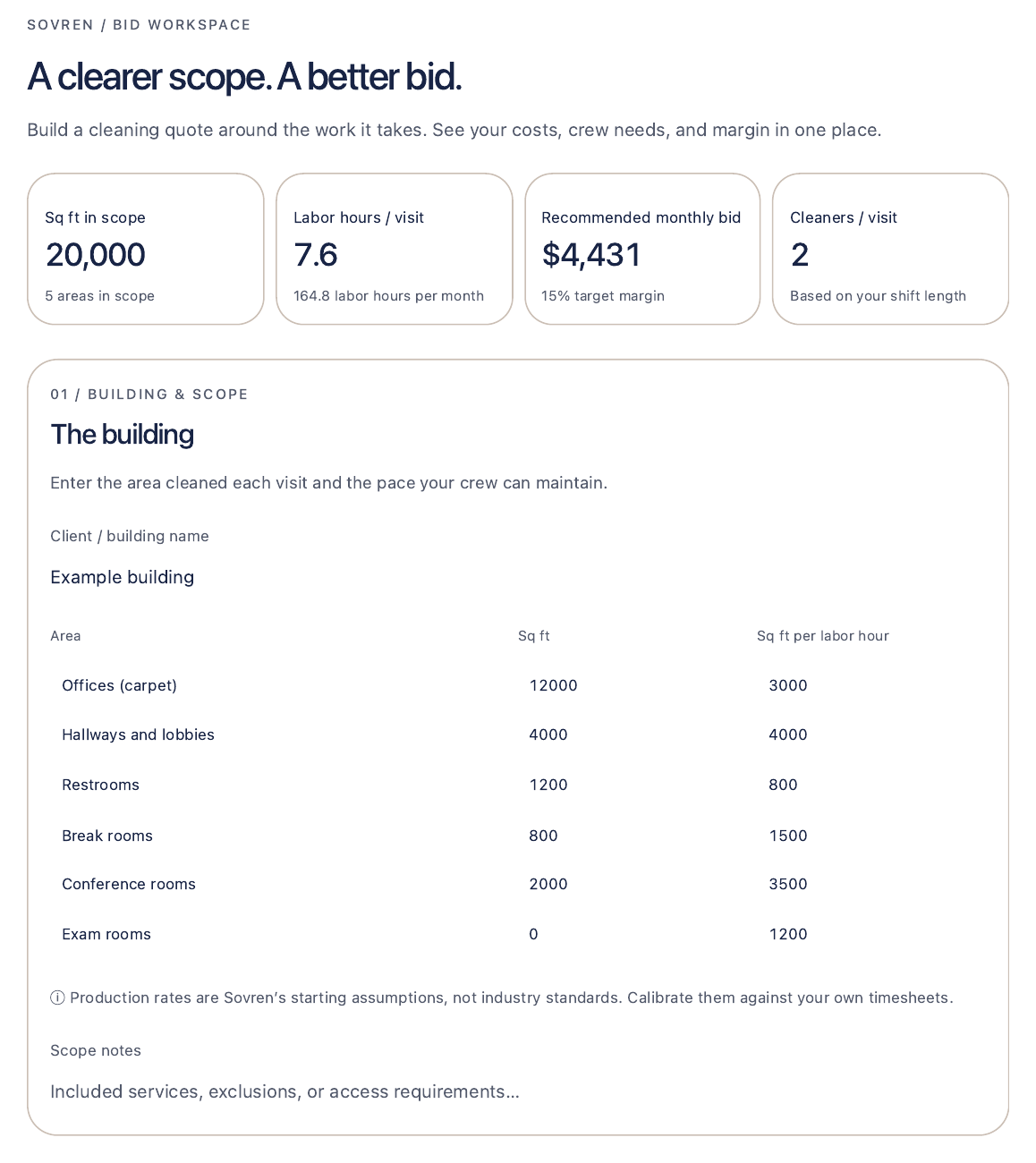
05Next stepsRecommended next phases and success measures.
- Calibrate production rates using the company’s timesheet data.
- Track actual against bid hours monthly, by account.
- Add drafting of bids from walkthrough notes.
- Generate client-ready proposals from completed bids.
Success measures: actual margin on new accounts compared with bid margin, and the time required to prepare a bid.
Discuss an operational challenge.
Contact us to discuss your operations and where improvement would have the greatest financial impact.
or email llcsovren@gmail.com